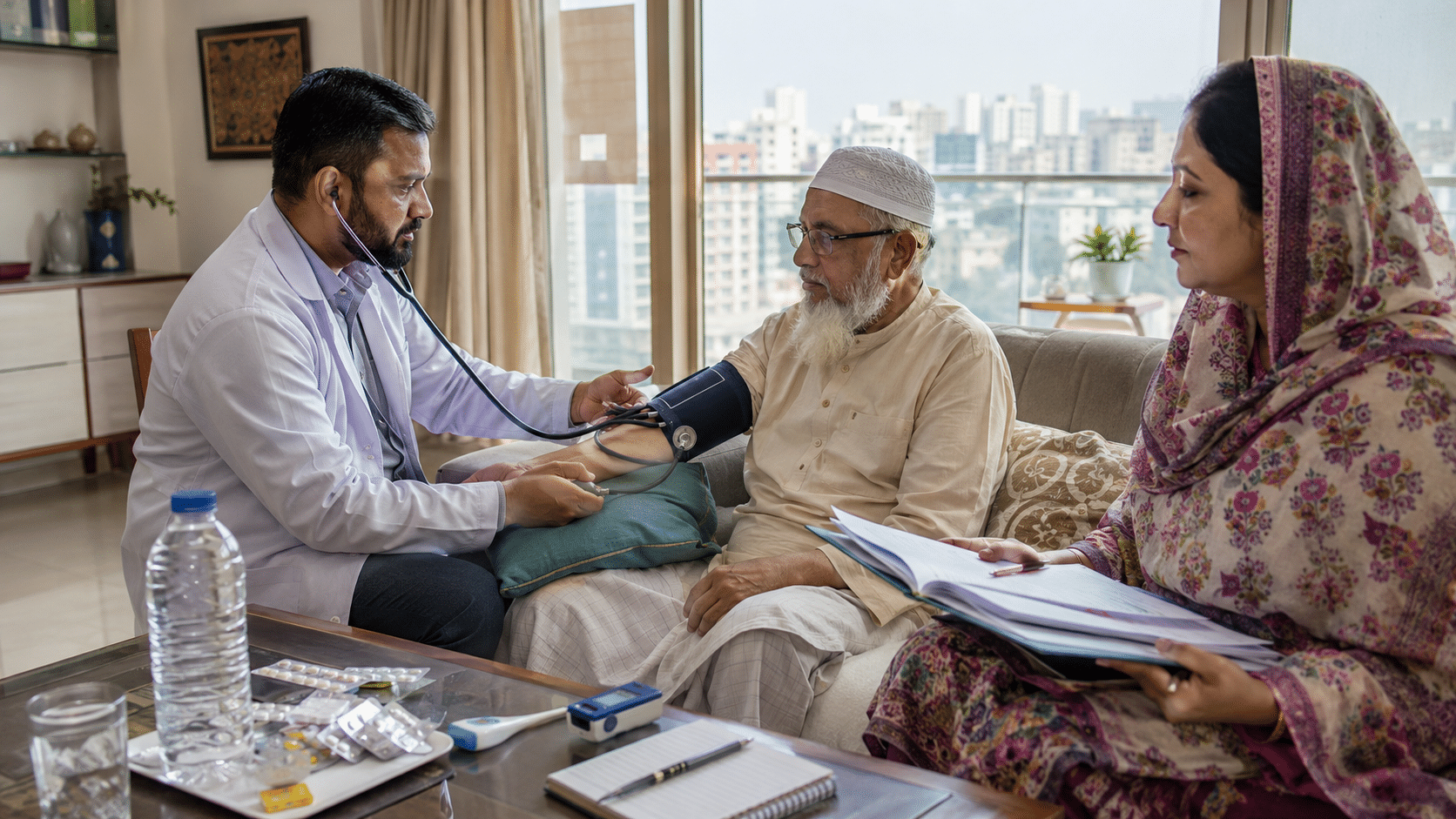
Before a doctor home visit, keep the patient’s medical records, current medicines, allergy information, symptom timeline, identification, recent test reports, and a clean examination area ready. You should also provide the doctor with clear directions to your home and make sure a responsible family member is available to answer questions.
Preparing these items in advance helps a home visit doctor in Dhaka assess the patient more efficiently, avoid medication mistakes, and decide whether home treatment, diagnostic testing, specialist care, or hospital transfer is necessary.
What Is a Doctor Home Visit?
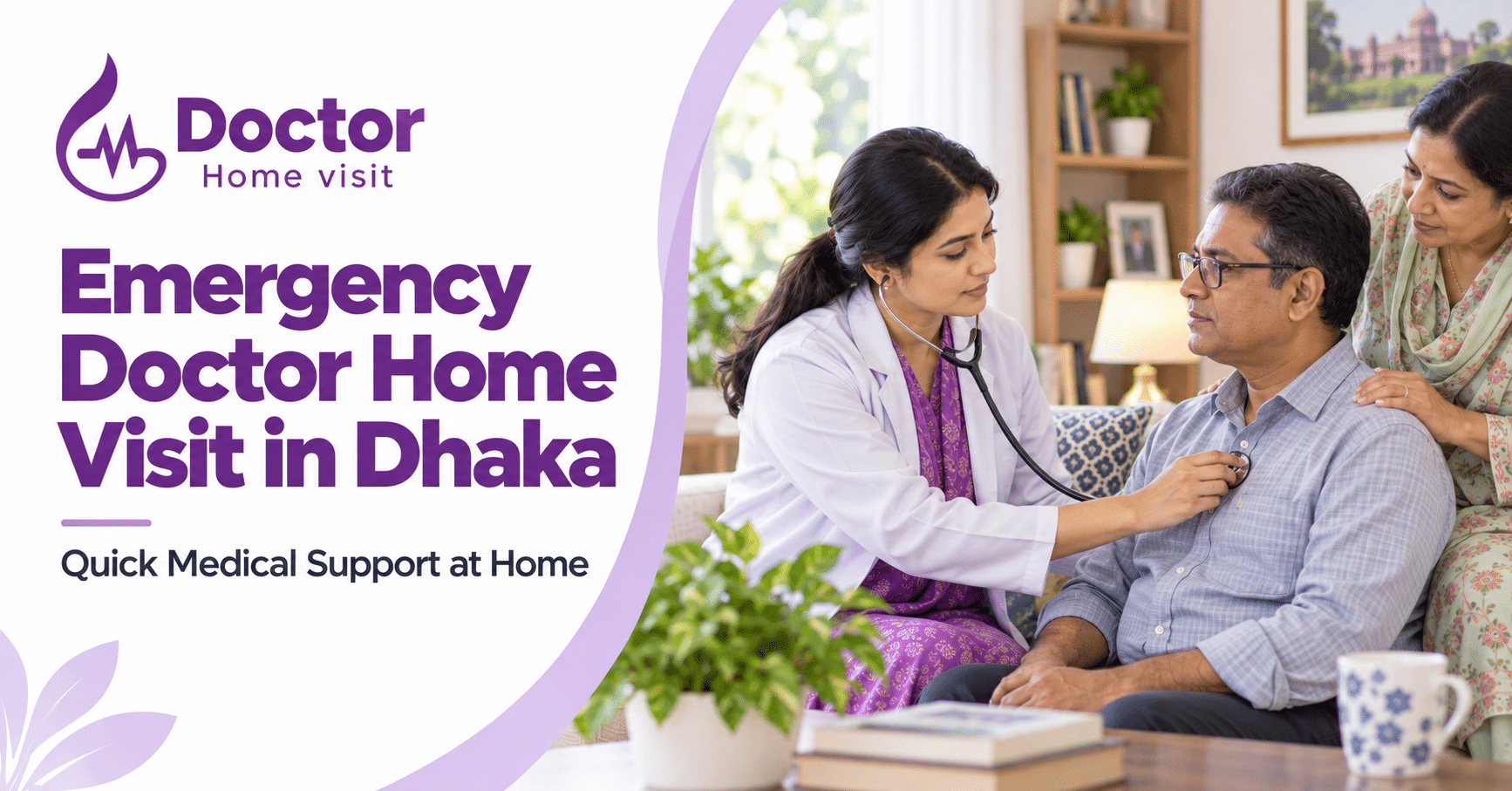
A doctor home visit is an in-person medical consultation conducted at the patient’s home instead of at a clinic or hospital.
During the visit, an MBBS doctor or another appropriately qualified medical professional may:
- Review the patient’s symptoms and medical history
- Check temperature, blood pressure, pulse, breathing, and oxygen saturation
- Perform a basic physical examination
- Review medicines and previous prescriptions
- Provide medical advice or a prescription when clinically appropriate
- Recommend laboratory tests or diagnostic imaging
- Arrange a follow-up consultation
- Recommend hospital assessment when home-based care is not sufficient
A doctor at home in Dhaka can be particularly useful for elderly patients, people with mobility limitations, patients recovering after hospitalization, individuals with chronic diseases, and families seeking an urgent first medical assessment without travelling through Dhaka traffic.
Doctor Home Visit BD advertises regular and urgent home consultations, general health checks, chronic disease follow-up, emergency first assessment, and post-hospital follow-up services in Dhaka.
Quick Checklist What Should You Keep Ready?
Before the doctor arrives, prepare these ten things:
- The patient’s main complaint and symptom timeline
- All current medicines, supplements, and inhalers
- Previous prescriptions and medical records
- Recent laboratory, imaging, or hospital reports
- A list of allergies and previous medicine reactions
- Current temperature, blood pressure, glucose, or oxygen readings
- The patient’s identification and booking information
- A clean, well-lit examination space
- A responsible attendant or family member
- Payment details and the agreed visit fee
Medical appointment guidance commonly recommends writing down symptoms, preparing two or three important questions, and bringing a complete list of medicines, vitamins, and supplements.
1. Write Down the Patient’s Main Symptoms
Do not rely on memory when explaining the patient’s condition. Write a short symptom summary before the home call doctor in Dhaka arrives.
Include:
- The main symptom
- When it started
- Whether it started suddenly or gradually
- Whether it is improving or worsening
- What makes it better or worse
- Any related symptoms
- Any treatment already given
- Whether another household member has similar symptoms
For fever, note the highest measured temperature and when it was recorded. For pain, note where it is located, how severe it is on a scale of 1 to 10, and whether it moves to another area. For breathing problems, note whether the patient becomes breathless while resting, speaking, walking, or lying down.
A Common Dhaka Home-Visit Scenario
Consider an elderly patient in Mirpur who has felt weak for three days. Telling the doctor only that the patient is “not feeling well” provides limited clinical information.
A more useful summary would be:
“The weakness started three days ago. The patient developed a temperature of 101°F last night, ate very little today, and felt dizzy while standing. Blood pressure was 100/65 this morning, and the last diabetes medicine was taken after breakfast.”
This type of information allows the visiting doctor to understand the situation more quickly and ask focused follow-up questions.
2. Keep Every Current Medicine Ready
Place all current medicines together in one bag or on a table. Do not show the doctor only the medicine you believe is related to the current illness.
Prepare:
- Prescription medicines
- Over-the-counter medicines
- Diabetes medicines or insulin
- Blood pressure medicines
- Blood thinners
- Inhalers and nebulizer solutions
- Eye drops
- Skin creams
- Vitamins and nutritional supplements
- Herbal or traditional products
- Recently stopped medicines
Keep the original packaging whenever possible. The doctor needs to see the exact medicine name, strength, dose, and instructions.
For example, saying “the patient takes one pressure tablet” is not enough because many blood pressure medicines look similar. Showing the strip or bottle helps prevent confusion.
A complete medicine list is important because medicines, supplements, and herbal products may affect symptoms, treatment options, or the risk of side effects.
Do Not Change Medicines Before the Visit
Do not stop, double, or replace a prescribed medicine unless a qualified doctor has already instructed you to do so.
If the patient missed a dose, took an extra dose, or received medicine from another doctor, tell the visiting doctor clearly. Hiding this information can lead to an unsafe treatment decision.
3. Prepare Previous Prescriptions and Medical Records
Keep the patient’s relevant medical records in one folder. Digital copies on a phone can help, but printed reports are often easier to review during a physical examination.
Useful documents include:
- Previous prescriptions
- Hospital discharge summaries
- Operation notes
- Vaccination records
- Chronic disease records
- Specialist consultation notes
- Previous ECG reports
- Laboratory test results
- X-ray, CT, MRI, or ultrasound reports
- Pregnancy-related records
- Records of previous medicine reactions
Tell the doctor about past or current medical conditions, previous operations, and relevant family medical history. These details can affect the assessment and treatment plan.
Organize Records by Date
Arrange reports from newest to oldest. Place the most recent prescription and test results at the front.
A large, mixed bundle of reports can waste valuable consultation time. A dated folder helps a private doctor at home in Dhaka identify recent changes without searching through years of unrelated paperwork.
4. Make a Clear Allergy List
Write down any known allergies, including:
- Medicine allergies
- Food allergies
- Adhesive or latex reactions
- Previous severe skin reactions
- Breathing problems after taking a medicine
- Swelling of the face, lips, or tongue
- Previous anaphylaxis
Do not simply say, “This medicine does not suit the patient.” Explain what happened.
For example:
- “Amoxicillin caused a widespread rash.”
- “A painkiller caused facial swelling and breathing difficulty.”
- “The patient developed severe vomiting after taking this antibiotic.”
The doctor needs to distinguish between a true allergy, a predictable side effect, and an unrelated symptom.
5. Record Available Vital Signs
You do not need to purchase medical equipment before arranging a doctor on call in Dhaka. However, if your household already has reliable devices, record recent measurements.
Helpful readings may include:
- Temperature
- Blood pressure
- Pulse rate
- Blood glucose
- Oxygen saturation
- Body weight
Write down the time each reading was taken. A single number without a time or context may be misleading.
For example:
“Oxygen saturation was 95% while sitting at 8:00 p.m., but fell to 91% after walking to the bathroom.”
Do not delay urgent care while repeatedly checking a device, and do not assume that a normal reading rules out a serious condition. Home devices may also give inaccurate results when batteries are low, hands are cold, the patient is moving, or the equipment is being used incorrectly.
6. Prepare a Clean and Well-Lit Examination Area
A home visit does not require a hospital-style room, but the doctor needs enough space to examine the patient safely and respectfully.
Before the doctor arrives:
- Improve the lighting
- Clear unnecessary furniture
- Provide access to both sides of the bed when possible
- Keep pets in another room
- Reduce noise from televisions and visitors
- Provide a chair and small clean table
- Keep tissues and a waste bin nearby
- Maintain ventilation without making the patient uncomfortably cold
- Ensure reasonable privacy
In Dhaka apartments, bedrooms can be crowded, and building access may be controlled by security staff. Inform the building guard that a doctor is expected and make sure the lift, gate, or entry instructions are clear.
7. Provide Accurate Dhaka Location Details
Dhaka addresses can be difficult to locate, especially at night or in areas with similar road, block, and house numbers. Sending only a neighborhood name may delay an urgent doctor home visit.
Provide:
- Patient’s full name
- Mobile number
- House or building name
- House number
- Road number
- Block or sector
- Area and police station
- Floor and apartment number
- Nearby landmark
- Building entry instructions
- Google Maps pin when available
- Alternative contact number
For a booking in Uttara, include the sector and road number. For Bashundhara Residential Area, mention the block and nearby gate. In Mirpur, specify the section or block. In Dhanmondi, include the exact road and nearby landmark.
If the doctor is coming during heavy rain, late at night, or during peak traffic, keep your phone available and answer unfamiliar numbers related to the booking.
8. Arrange for a Responsible Family Member
Whenever possible, one informed adult should remain with the patient throughout the visit.
This person can:
- Explain the medical history
- Show medicines and reports
- Take notes
- help an elderly or confused patient communicate
- Ask questions about treatment
- Understand warning signs
- Arrange tests or hospital transport
- Confirm follow-up instructions
Having a family member or trusted companion present can help patients understand and remember medical instructions.
Too many people in the room, however, can make communication difficult. Select one main spokesperson and allow the patient to answer directly whenever the patient is able.
9. Prepare the Questions You Need Answered
Write down the two or three questions that matter most.
Useful questions include:
- What may be causing these symptoms?
- Is home treatment appropriate?
- Does the patient need any tests?
- Which medicine should be started, stopped, or continued?
- What side effects should we watch for?
- When should the patient be reviewed again?
- Which symptoms require immediate hospital care?
- Can the patient eat, walk, bathe, or travel normally?
- Does the patient need a specialist doctor home visit?
- Who should we contact if the condition worsens?
Before the doctor leaves, repeat the plan in your own words. This helps confirm that you correctly understand the prescription, tests, warning signs, and follow-up schedule.
10. Do Not Hide Sensitive but Relevant Information
Medical decisions depend on accurate information. Tell the doctor about relevant matters even when they feel embarrassing or uncomfortable.
This may include:
- Pregnancy or possible pregnancy
- Smoking or tobacco use
- Alcohol or substance use
- Recent travel
- Sexual health concerns
- Mental health symptoms
- Falls or injuries
- Self-medication
- Unprescribed antibiotics
- Herbal treatments
- Previous overdose or medication error
A visiting doctor is there to make a safe clinical assessment, not to judge the patient.
Common Mistakes Before a Home Doctor Visit
Families frequently reduce the value of the consultation by making avoidable preparation mistakes.
Mistake 1: Giving Medicine Without Recording It
Always write down what was given, how much was given, and at what time.
Mistake 2: Hiding Old Prescriptions
An old prescription may explain the patient’s current medicine regimen, previous diagnosis, or treatment response.
Mistake 3: Cleaning Away Important Evidence
Do not discard vomit, urine samples, medicine packets, or photos of a rash when they may help explain what happened. You do not necessarily need to keep biological material, but a clear photograph or written description can be useful.
Mistake 4: Waiting for Every Family Member
Choose one decision-maker. Do not delay a medically necessary visit while waiting for relatives to arrive.
Mistake 5: Expecting Hospital-Level Treatment at Home
A house call doctor in Dhaka can assess, advise, prescribe when appropriate, and recommend the next level of care. A home consultation cannot replace hospital facilities needed for major trauma, advanced imaging, continuous cardiac monitoring, emergency surgery, or intensive care.
Mistake 6: Requesting Antibiotics Without an Assessment
Antibiotics are not appropriate for every fever, cough, sore throat, or stomach problem. The doctor should decide whether an antibiotic is clinically indicated.
Safety Warning: When Not to Wait for a Home Visit
A 24/7 doctor home visit in Dhaka can provide valuable urgent assessment, but some symptoms require immediate emergency response or hospital care.
Call Bangladesh’s national emergency service on 999 or arrange immediate emergency transport when the patient has:
- Severe difficulty breathing, gasping, choking, or inability to speak
- New chest pressure or severe chest pain
- Pain spreading to the arm, back, neck, or jaw
- Sudden facial weakness, arm weakness, or difficulty speaking
- Sudden loss of consciousness
- A seizure that does not stop or repeated seizures
- Heavy uncontrolled bleeding
- Severe injury after a fall or road accident
- Blue, grey, or extremely pale lips or skin
- Sudden severe confusion
- Suspected poisoning or overdose
- A severe allergic reaction with swelling or breathing difficulty
- Immediate risk of self-harm
Bangladesh’s 999 service connects callers with emergency assistance, including ambulance, police, and fire services. Severe breathing difficulty, chest heaviness, spreading chest pain, sudden confusion, and stroke signs are recognized emergency warning signs.
Do not wait for a same-day home doctor visit when every minute may affect the outcome.
How Much Does a Doctor Home Visit Cost in Dhaka?
The cost of a visiting doctor service in Dhaka can vary based on:
- Patient location
- Time of the visit
- Doctor’s experience or seniority
- Routine versus urgent booking
- Patient condition
- Travel distance
- Specialist requirements
- Weekend or late-night availability
- Additional procedures or services
Published information from Doctor Home Visit BD indicates a fee of approximately ৳5,000 per visit for an experienced SHO/RMO doctor and approximately ৳7,000 for a senior doctor, although the final charge can depend on the circumstances of the booking.
Before confirming the visit, ask:
- What is the total consultation fee?
- Is transportation included?
- Is there an additional urgent or nighttime charge?
- Are tests, injections, dressings, or procedures charged separately?
- Is follow-up included?
- What payment methods are accepted?
Never assume that laboratory tests, medicines, ambulance transport, nursing procedures, or specialist consultations are included in the basic doctor visit fee.
Dhaka Coverage Main Neighborhoods and Nearby Areas
Demand for a home doctor service in Dhaka comes from both central neighborhoods and developing residential zones.
Common Dhaka service locations include:
- Gulshan
- Banani
- Baridhara
- Bashundhara Residential Area
- Badda
- Rampura
- Dhanmondi
- Mohammadpur
- Lalmatia
- Mirpur
- Pallabi
- Uttara
- Nikunja
- Khilkhet
- Tejgaon
- Farmgate
- Motijheel
- Wari
- Old Dhaka
- Jatrabari
Doctor Home Visit BD specifically identifies availability in areas including Uttara, Gulshan, Mirpur, Dhanmondi, and Mohammadpur.
Greater Dhaka and Nearby Zones
Families may also request home visits in nearby Greater Dhaka locations such as:
- Tongi
- Savar
- Ashulia
- Keraniganj
- Narayanganj
- Demra and surrounding areas
Availability in outer areas should be confirmed before booking because travel time, traffic, weather, doctor location, and the urgency of the patient’s condition may affect whether a visit can be arranged.
When booking outside central Dhaka, provide a live location pin and ask for an estimated arrival window before making medical decisions based on the visit.
Home Doctor Visit vs Online Consultation
An online consultation may be appropriate when the patient mainly needs advice, a report review, or routine follow-up and does not require a physical examination.
A home visit may be more suitable when:
- The patient is elderly or unable to travel
- Vital signs need to be checked
- The doctor needs to examine the chest, abdomen, throat, skin, or joints
- The patient recently left the hospital
- Symptoms are new or changing
- The family is unsure whether hospital care is needed
Hospital assessment is more appropriate when the patient may need emergency treatment, advanced testing, surgery, continuous monitoring, or admission.
The safest choice depends on the patient’s symptoms—not simply convenience or cost.
Prevention and Ongoing Home-Care Preparation
Do not wait until someone becomes ill to organize medical information. A simple household health system can make future consultations safer.
Maintain a Medical Folder
Keep one folder for each family member containing:
- Current diagnoses
- Updated medicine list
- Allergy information
- Previous prescriptions
- Recent test results
- Specialist reports
- Emergency contact details
Update the Medicine List Monthly
Remove discontinued medicines and add new prescriptions. Record the dose and timing clearly.
Check Home Equipment
If you use a thermometer, blood pressure monitor, glucose meter, or pulse oximeter:
- Check the batteries
- Store the device correctly
- Keep instructions nearby
- Replace expired glucose strips
- Clean reusable equipment appropriately
Store Medicines Safely
Keep medicines away from children, heat, direct sunlight, and moisture. Do not mix loose tablets in an unlabelled container.
Know Your Emergency Route
Identify the nearest appropriate hospital and keep emergency transport numbers available. Dhaka traffic conditions can change quickly, so families caring for elderly or high-risk patients should plan more than one route.
When to Call a Professional in Dhaka
Call a qualified medical professional in Dhaka when:
- Fever is persistent or worsening
- A patient is unusually weak, drowsy, or dehydrated
- Blood pressure or glucose readings are repeatedly abnormal
- A chronic condition suddenly becomes difficult to control
- A new medicine causes possible side effects
- An elderly patient has a new fall, confusion, or reduced appetite
- A recently discharged patient develops new symptoms
- A wound becomes painful, swollen, red, or produces discharge
- A child, pregnant patient, or medically vulnerable person develops concerning symptoms
- You are unsure whether home care is safe
An urgent doctor home visit in Dhaka may be appropriate for a prompt first assessment when the patient is stable enough to remain at home. An emergency doctor home visit should never be used to delay ambulance assistance or hospital treatment for life-threatening symptoms.
Why Choose Us for Home Doctor Service in Dhaka?
Doctor Home Visit BD is designed for patients who need professional medical attention at home without the difficulty of travelling to a clinic.
Reasons families may consider the service include:
Home-Based Convenience
Patients can receive an in-person assessment in familiar surroundings, which is especially helpful for elderly, weak, recovering, or mobility-limited patients.
Regular and Urgent Availability
The service advertises regular and urgent doctor visits in Dhaka, including 24/7 availability subject to booking and doctor availability.
Different Types of Home Care
Available services are described as including general health assessments, chronic disease management, urgent first assessment, and post-hospital follow-up.
Local Dhaka Coverage
The service supports bookings across major residential areas, including Gulshan, Dhanmondi, Uttara, Mirpur, and Mohammadpur.
Clearer Booking Preparation
Families can provide the patient’s symptoms, location, medical history, and urgency during booking so the service can determine the appropriate next step.
When requesting an MBBS doctor home visit in Dhaka, a registered doctor home visit, or a specialist doctor home visit in Dhaka, confirm the doctor category, expected fee, visit timing, and whether the patient’s condition is suitable for home assessment.
Book a Doctor Home Visit in Dhaka
Good preparation allows the doctor to spend more time assessing the patient and less time searching for medicines, reports, addresses, and missing information.
Keep the patient’s symptom history, medicines, allergies, test reports, vital-sign readings, and questions ready. Provide an accurate Dhaka address, arrange a responsible attendant, and never delay emergency care for severe or life-threatening symptoms.
FAQs
1. What should I prepare before a doctor home visit in Dhaka?
Prepare the patient’s medicines, medical records, allergy list, symptom timeline, recent test reports, vital-sign readings, and a clean examination area.
2. Can I request a same-day doctor home visit in Dhaka?
Same-day visits may be available depending on the patient’s location, condition, booking time, and doctor availability.
3. Is a doctor at home suitable for an elderly patient?
A home doctor visit can be helpful for a stable elderly patient who has mobility problems, chronic disease concerns, new symptoms, or needs post-hospital follow-up.
4. Does a home visit doctor bring medical equipment?
A visiting doctor may carry basic assessment equipment, but you should confirm available services and equipment when booking.
5. How much does a house call doctor cost in Dhaka?
Published prices indicate approximately ৳5,000 for an experienced SHO/RMO visit and approximately ৳7,000 for a senior doctor, although location, time, and urgency can change the final fee.
6. Can a home doctor prescribe medicine?
A qualified doctor may issue a prescription after assessing the patient when medication is clinically appropriate.
7. Can I request a specialist doctor home visit in Dhaka?
Specialist home visits may depend on the required specialty, patient location, urgency, and specialist availability, so confirm this during booking.
8. Which Dhaka areas can receive home doctor services?
Home visits may be available in areas including Gulshan, Banani, Dhanmondi, Mohammadpur, Mirpur, Uttara, Bashundhara, Badda, and surrounding neighborhoods.
9. Should I book a home doctor for severe chest pain?
No, severe or persistent chest pain—especially with sweating, breathing difficulty, or spreading pain—requires immediate emergency assistance through 999 or urgent hospital care.
10. How can I help the doctor find my Dhaka address quickly?
Send the full address, road and block details, floor number, nearby landmark, entry instructions, active phone number, and a live Google Maps location.