
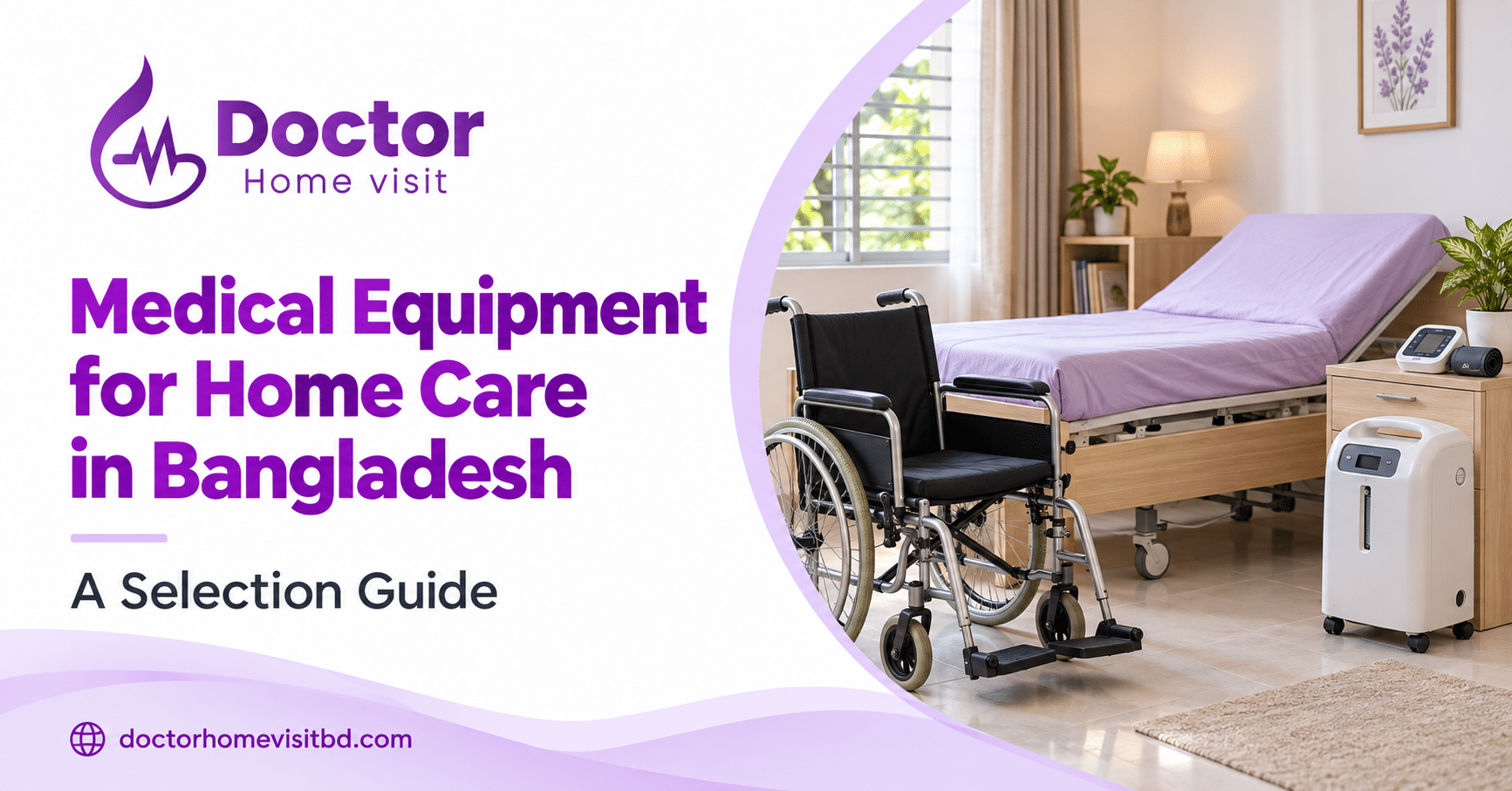
Choosing medical equipment starts with the patient’s needs, not the supplier’s most expensive model. A suitable device must match the clinical plan, fit the home, be manageable for its users and come with appropriate instructions and support. A good price matters, but it cannot answer those questions by itself.
For families in Bangladesh, buying a wheelchair or arranging an oxygen concentrator can feel like learning a new language overnight. Which features matter? Who checks the setup? What happens if something stops working? This guide from Doctor Home Visit BD helps you prepare the right questions before arranging equipment for home care.
What Counts as Medical Equipment for Home Care?
Home medical equipment includes devices used to support monitoring, movement, positioning or prescribed treatment outside a hospital. Some are relatively simple to operate; others require professional assessment, setup and continuing clinical oversight.
The useful question is not “Which devices should every home have?” It is “What problem are we trying to solve for this person?” Start with that problem and follow a selection process before comparing products.
| Selection step | Question to answer | Appropriate input |
| Define the need | What activity or care requirement needs support? | Patient, family and treating professional |
| Confirm suitability | Which device type and specifications are appropriate? | Relevant clinician or equipment professional |
| Check the environment | Will it fit, work and be usable in this home? | Professional assessment and supplier information |
| Verify the item | What is its identity, condition and service history? | Supplier and manufacturer documentation |
| Prepare the users | Who needs training and a backup plan? | Clinician, supplier and actual daily users |
| Agree follow-up | Who reviews fit, function and changing needs? | Named clinical and technical contacts |
Monitoring, mobility and support devices
A blood pressure monitor records a measurement; a wheelchair supports mobility; an adjustable bed can assist positioning and everyday care. Respiratory equipment serves a different purpose again. Grouping devices by their intended role makes it easier to understand why one product cannot automatically replace another.
A medical supply may also be a consumable used with equipment, such as a compatible accessory specified for a particular model. Check what is reusable, replaceable or single-use. Do not assume every item in a photograph is included, or that accessories from a similar-looking device will fit safely.
Matching equipment to a clinician plan
Write down the intended outcome before discussing specifications. Is the goal to support a transfer, record an agreed measurement or deliver prescribed therapy? Ask the responsible professional what the equipment should do and which limitations matter. Keep that requirement separate from the salesperson’s description.
For example, “we need something for weakness” is too broad to guide a purchase. Explain what the patient finds difficult and what assessment has already taken place. The answer may involve physiotherapy and caregiver support, clinical review or changes to the home as well as equipment.
When a Doctor Should Assess Equipment Needs
A doctor should assess medical concerns and determine when a device forms part of treatment. Other qualified professionals may contribute assessments for seating, mobility, nursing requirements or technical setup within their expertise.
Ask for professional direction before arranging respiratory support or equipment intended to manage a clinical problem. A product listing cannot establish why symptoms are happening or whether treatment at home is appropriate.
Diagnosis and care goals
Explain the diagnosis if known, recent changes, discharge instructions and the difficulties the family is trying to manage. People with the same condition may have different equipment needs. A device that helped a neighbour does not establish the right choice for another patient.
The clinical goal should be understandable to everyone involved. Perhaps the patient needs a suitable seating assessment, or the family needs instructions about home monitoring. Ask who will review the goal and when. If the requirement changes, the existing equipment may need reassessment rather than an improvised modification.
Prepare a short account of an ordinary day before the appointment. Explain where the person sits, how they reach the bathroom and who helps when relatives are away. For someone with chronic illnesses, include the existing care instructions and relevant reports. These details help turn a general request into an assessment question. You do not need to identify the correct product beforehand; describing the difficulty clearly is a useful first step towards an appropriate recommendation.
Prescriptions, sizing and compatibility
Ask what written clinical instructions are needed for the proposed device. Oxygen therapy requires appropriate medical direction; some other products mainly require assessment, correct sizing and training. Avoid assuming that every device has the same prescription requirements or that an overseas regulatory label establishes local requirements.
Confirm the relevant dimensions, user weight limits, accessories, power requirements and compatibility information. If a different model is offered, ask the responsible professional whether it meets the original requirement. “Equivalent” should describe a checked match, not simply the supplier’s alternative stock. Keep the agreed specifications available for the delivery team.
Common Categories of Home Medical Equipment
Equipment categories help you choose which questions to ask next. They are not a shopping list, and owning more devices does not automatically create better healthcare at home.
Use the focused guides linked here for the surrounding care issues. A detailed clinical or technical recommendation should still relate to the individual patient and the specific model supplied.
Mobility and pressure-care support
Mobility equipment can include wheelchairs and other assessed aids. WHO’s wheelchair guidance emphasises individual assessment, fitting, training and follow-up. Ask how the device supports the person’s daily activities, who will assist them and whether the actual home allows it to be used as intended.
Beds, mattresses and cushions may form part of pressure-care planning. They do not guarantee prevention of pressure injuries or remove the need for assessed care. The broader home nursing guide and physiotherapy guide can help families identify the professional discussions needed around equipment.
For children, ask for an assessment that considers the intended user rather than simply choosing a smaller adult product. Families arranging elder care should likewise describe the individual’s abilities instead of assuming that age determines the specification. Keep a note of the recommended features and the reason for each one. This makes it easier to compare proposals without turning the discussion into a contest over which model has the longest feature list.
Monitoring and prescribed respiratory support
Monitoring equipment may include a blood pressure monitor, glucometer or pulse oximeter when appropriate. Ask what to measure, how to record it and which changes require professional advice. A number on a screen does not independently diagnose a medical condition, and pulse oximeter readings have recognised limitations.
Prescribed respiratory support can involve oxygen equipment or other specialised devices, depending on assessed needs. Do not confuse oxygen delivery, nebulisation and ventilation as interchangeable treatments. For context about limits and staffing, read the complex home-care guide; for equipment arrangements, use the existing rental guide.
Hospital Beds, Mattresses and Wheelchairs
Beds and wheelchairs need to work for the patient and the people assisting them. A feature that looks convenient in a showroom may be difficult to use in a small bedroom or narrow corridor.
Arrange an appropriate assessment before choosing specifications. Discuss comfort, function, transfers, pressure-care needs and the practical demands on family members or paid staff.
Patient mobility and caregiver needs
Explain how the patient currently moves and where help is required. Can they reposition independently? Who assists with transfers? Is there an existing therapist or nursing assessment? These questions help the professional understand the whole task rather than selecting equipment by diagnosis alone.
Ask how the proposed mattress or seating system fits the wider care plan. An “anti-bedsore” label is not a promise that pressure damage cannot occur. Individual risk assessment, appropriate support surfaces and an agreed approach to care remain important. Do not substitute a supplier’s generic schedule for clinical instructions.
Questions to ask the responsible professional
Use a concise checklist during the assessment. Ask the professional to explain recommendations in language the patient and regular caregiver can understand.
- What dimensions and weight capacity are required?
- Which positioning or seating features are appropriate?
- Are rails needed, and what risks must be assessed?
- What training or staffing is needed for transfers?
- When should fit, comfort and pressure-care needs be reviewed?
Keep the answers with the care records. If the supplied item differs from the assessed specification, resolve the difference before relying on it.
Space, sizing and transfer considerations
Measure the delivery route as well as the intended room. Include doors, lift dimensions, corners and the space needed by assisting adults. Ask whether a bed can be assembled in place and whether a wheelchair can be used along the necessary route without unapproved changes.
Bed frames, mattresses and rails must be compatible. MHRA guidance describes entrapment risks involving gaps between these components. A rail should not be treated as an automatic safety upgrade. Ask for individual assessment and correct installation rather than adding rails or extra mattress layers independently.
Include the regular caregiver in the discussion about space and operation. If a family member works outside the home, the person actually assisting during the day needs to understand the arrangement too. Ask the assessor to consider the intended route between bed, chair and bathroom. Photographs or measurements may help the preliminary discussion, but ask whether an in-person check is needed before the specification can be finalised. Do not conceal access difficulties to secure delivery.
Oxygen and Respiratory Equipment: Questions for the Clinician
Respiratory equipment needs clinical direction because the right approach depends on the patient’s condition. Breathlessness alone does not establish which device, if any, should be used at home.
If someone has severe breathing difficulty, blue or grey colouring, collapse or unresponsiveness, seek immediate emergency help. Do not wait for a delivery, refill, sales reply or routine doctor visit to resolve an emergency.
Device suitability
Ask the clinician whether an oxygen concentrator, another oxygen source or a different treatment approach is appropriate. Discuss the exact type of delivery required and whether the proposed model can meet the prescription. Do not choose by a headline capacity or assume portable and stationary devices are interchangeable.
This guide does not prescribe oxygen flow rates or ventilation settings. Obtain written instructions from the responsible healthcare professional, including review and escalation arrangements. If the supplier proposes a substitute, ask the clinician to confirm suitability before use. A family member should not independently adjust treatment because the device has more available settings.
Setup, training and maintenance
Ask who installs the device, demonstrates normal operation and explains alarms or faults. Users need instructions for the supplied model and approved accessories. Ask which cleaning and routine maintenance tasks belong to the household and which require trained technical staff.
Discuss oxygen fire precautions, including no smoking near oxygen equipment and keeping it away from flames and heat sources. Ask the supplier and clinician to agree a device-specific plan for interruptions and backup support. Do not assume a battery, cylinder, refill arrangement or replacement device is included unless confirmed.
Checking a Medical Equipment Supplier in Bangladesh
A supplier should be able to explain what they are providing and who supports it after delivery. A familiar logo or a low quote cannot establish that a particular item is genuine, appropriate or properly maintained.
Use the checklist below to compare evidence. It is a verification framework, not a ranking of the best suppliers in Bangladesh or a guarantee about any business.
| Check | Evidence or answer to request | Question if unclear |
| Supplier identity | Business name, address and named contact | Who issues the invoice and handles complaints? |
| Device identity | Manufacturer, model and serial number where applicable | Does the documentation match this exact unit? |
| Product condition | Written description of new, used or refurbished status | What work was completed before supply? |
| Genuine supply route | Manufacturer or authorised distributor evidence where claimed | How can the claim be independently checked? |
| Relevant conformity documents | Applicable product and market documentation | Which exact model and jurisdiction do they cover? |
| Reprocessing and servicing | Applicable dated records for the supplied unit | What evidence links the record to this item? |
| User documentation | Model-specific instructions and required accessories | Can the actual users understand and follow them? |
| Support responsibility | Written warranty and technical support terms | Who handles faults, parts and escalation? |
Documentation and genuine products
Ask for an invoice that identifies the item accurately, alongside model-specific documents. Where a supplier claims authorised distribution or regulatory clearance, verify the exact claim through the relevant organisation. A certificate for another model or a general marketing badge does not establish the status of the device delivered.
Avoid treating labels such as “hospital grade,” “imported” or “100% original” as complete evidence. Ask what they mean and what records support them. Do not confuse a supplier’s business registration with product-specific documentation. Keep copies of relevant records so future technical enquiries can identify the correct equipment.
When comparing suppliers, send the same requirement to each one and request a response against it. If one proposes a different model, ask for the differences to be explained separately. Keep promotional photographs apart from the written item description, especially when a listing shows several accessories together. Ask what will appear on the delivery record and how you can check the actual unit on arrival. This creates a clearer trail than relying on a series of informal messages.
Warranty and after-sales support
Confirm who provides the warranty: manufacturer, distributor or seller. Ask which parts, labour and transport are included, which exclusions apply and how a claim is made. Written terms matter more than a verbal promise that “everything is covered.”
Ask what happens while the device is being assessed or repaired. Is temporary equipment offered, subject to availability, or separately charged? Do not assume an immediate replacement. The family needs to understand service hours and the agreed contingency plan before relying on equipment for an essential care requirement.
Cleaning, Maintenance and Calibration Records
Cleaning, disinfection, sterilization and calibration describe different processes. Cleaning removes soil; disinfection addresses many disease-causing microorganisms; sterilization eliminates all forms of microbial life through an appropriate validated process. The required approach depends on the item and its intended use.
Calibration concerns the relationship between an instrument’s measurements and an appropriate reference. It does not clean a device, and a cleaning record does not establish measurement accuracy. Ask which checks actually apply to the supplied model.
Device-specific manufacturer instructions
Request the manufacturer’s instructions for each reusable component and accessory. A wheelchair frame, electrical monitor and patient-contact respiratory accessory may need different handling. Do not immerse electrical equipment, mix cleaning agents or apply a method borrowed from another device unless the instructions specifically permit it.
WHO guidance treats reprocessing as a controlled sequence with appropriate quality checks. Ask whether an accessory is reusable or single-use, who processes it and what evidence is available. A blanket statement that every item is “sterilized” may obscure the actual applicable process. Families should receive understandable care instructions without being expected to reproduce professional reprocessing at home.
Service logs and fault reporting
Ask for relevant maintenance, inspection and calibration records, where required. They should identify the equipment, date, work performed, responsible technician or service organisation and next action. Preventive maintenance and repairs serve different purposes; a recent repair does not automatically establish that every scheduled check has been completed.
Record unusual alarms, damage or changes in performance and contact the agreed technical service. Do not open sealed components or bypass safety features. If the device supports essential treatment, follow the clinical contingency plan immediately. Seek urgent medical help if the patient deteriorates; a repair request is not a medical assessment.
Keep one equipment folder containing the invoice, identifiers, instructions and applicable service records. Add the date of any reported fault, whom you contacted and the advice received. When a replacement arrives, record its details rather than assuming the old paperwork applies. This helps the next technician or family member understand which unit is currently in use. The folder should be practical enough to maintain, not another complicated task that nobody can keep updated.
Buying Versus Renting Medical Equipment
The choice between buying and renting starts with expected need, clinical suitability and support arrangements. It is not simply a comparison between a purchase price and a rental headline.
Keep detailed rental charges, deposits and contract conditions in the medical equipment rental guide. Here, focus on whether ownership or temporary access better matches the patient’s likely situation.
Expected care duration
Renting may be worth considering when the requirement is temporary or likely to change, while buying may suit a continuing need. Neither option is automatically cheaper or more appropriate. Ask the treating professional whether the current device type is likely to remain suitable before making a long-term commitment.
For example, a recovery plan may involve a reassessment before further arrangements are made. In that situation, flexibility matters alongside the immediate price. If you buy, ask how future changes in sizing, function or prescribed support will be managed. Do not mistake ownership for a guarantee that the item will always meet the patient’s needs.
Items to confirm in writing
Write down the chosen specifications and the responsibilities attached to the arrangement. Keep detailed rental financial terms with the separate rental quotation rather than relying on this general guide.
- Exact model, condition, accessories and intended use.
- Delivery, setup and training responsibilities.
- Maintenance, inspection and replacement responsibilities.
- Warranty or applicable rental service support.
- Technical contacts and the agreed fault contingency.
Check that the written terms match the conversation. If a device changes before delivery, obtain updated confirmation rather than accepting an unexplained substitution.
Ownership costs and service support
Ownership can involve consumables, accessories, inspections, repairs, storage and eventual replacement. Rental arrangements may allocate some responsibilities differently. Ask what the family must organise under each option, without assuming that servicing is automatically included.
Consider practical capacity too. Can users store the device appropriately, identify faults and arrange professional servicing when due? A purchase that looks economical may be inconvenient if required support is unavailable locally. Obtain a quote tied to the same specifications when comparing routes, and request dated terms from the responsible supplier.
Avoid comparing a new purchase with an unspecified used rental item as though their condition and support were identical. Ask each supplier to describe its offer clearly, then discuss any clinical differences with the relevant professional. The sensible choice may change after reassessment. Keep that possibility in the family’s plan without assuming a particular resale value, guaranteed upgrade or automatic exchange. Those are commercial commitments that require their own written confirmation from the responsible business.
Preparing the Home for Delivery and Setup
Preparing for delivery should begin before the vehicle arrives. The supplier needs accurate access information, and the family needs to understand what must be ready before the patient relies on the equipment.
Do not treat an agreed delivery window as proof that installation, training or clinical readiness is complete. Confirm each responsibility separately and ask what happens if the home or device is unsuitable on arrival.
Space, power and access
Check the manufacturer’s environmental and power requirements with the supplier. FDA home-use guidance highlights the importance of the home environment, power compatibility and user capability. Do not choose an extension lead, adapter or backup power system without appropriate advice for the actual equipment.
Use this delivery-readiness checklist:
- Measure the entrance, lift, stairs and route into the room.
- Clear the installation area and space needed for care.
- Confirm the power supply and any required technical checks.
- Identify a suitable location following manufacturer instructions.
- Keep the prescription or specification available where relevant.
- Arrange for the actual user or caregiver to attend training.
- Confirm who signs off setup and whom to contact with concerns.
User training and backup arrangements
Ask the trainer to demonstrate the supplied model and then watch the regular user explain or demonstrate the essential actions. This helps reveal misunderstandings before the delivery team leaves. Record what remains unclear and arrange further instruction rather than pretending that a brief demonstration was enough.
For electrically dependent equipment, plan for power interruptions before use. FDA guidance recommends preparing for outages affecting medical devices. The appropriate backup depends on the device and clinical need, so agree it with the clinician and supplier. Keep written contacts and instructions accessible without relying on one phone or an internet connection.
Doctor-Advised Equipment Support in Dhaka
Doctor Home Visit BD’s equipment service page describes a clinical assessment and recommendation role. It identifies BD Medical Store as an independent referral partner that handles equipment supply arrangements separately.
This distinction matters when you need a medical opinion, a supplier quote or technical help. Ask which organisation is responsible for each part of the arrangement before making payment or relying on a promise.
Assessment and referral route
For a suitable non-emergency concern, explain the patient’s diagnosis if known, current symptoms, discharge advice and practical limitations. A doctor consultation can help clarify whether equipment is medically appropriate and which other professional assessments may be needed. An online discussion may still lead to an in-person assessment.
If you searched for doctor home service near me, ask about relevant expertise and assessment scope rather than location alone. A medical recommendation does not automatically include equipment delivery, technical installation, ongoing nursing or repairs. Confirm the clinical follow-up route and obtain the necessary specifications before approaching a supplier.
Partner delivery and quoted terms
Families may enquire with BD Medical Store about suitable items, availability and supply arrangements. The referral does not establish that Doctor Home Visit BD manufactures, wholesales, installs or maintains the equipment. Ask the supplier to identify its own responsibilities and any separate technical service provider.
Confirm the exact address, delivery access, device model and required date. Physical coverage, stock, setup and support must be checked directly; this article promises no response time or nationwide delivery. Keep the clinical recommendation, supplier quote and technical support information together, while recognising that each comes from a different responsible party.
For a Dhaka household coordinating several services, name one family contact for routine practical questions, with the patient’s agreement. Explain who should receive delivery updates and who can clarify the clinical recommendation. A supplier should not have to guess which relative can approve an alternative, and a relative should not make a clinical substitution without appropriate confirmation. Clear communication keeps a change in stock from silently becoming a change in the patient’s treatment or support plan.
Choose Equipment Around the Patient
Suitable medical equipment should solve an assessed problem and fit the patient’s home, abilities and care plan. Specifications, training and reliable support deserve attention alongside price.
Use a written requirement as your reference point so alternatives can be checked without losing sight of the original need. The best next step is a clear conversation with the responsible professional, followed by a documented check that the proposed device and support arrangements match what the patient actually needs.
Confirm requirements
Ask the relevant professional to clarify suitability, sizing, accessories and any clinical instructions. Resolve unanswered questions before relying on the device.
Check its identity, condition and applicable cleaning or service records. Agree who reviews changing needs and handles technical faults.
Request a suitable quote
Visit doctor-advised medical equipment support in Dhaka to enquire about assessment and the referral route.
Request a supplier quote based on confirmed requirements, with setup, training and support responsibilities explained in writing.
Frequently Asked Questions
Q1: Should I buy or rent?
Compare expected duration, the likelihood of changing needs and access to servicing. Buying may suit an ongoing requirement, while renting may offer useful flexibility. Neither route is automatically the right financial or clinical decision.
Ask for quotes against the same specification and clarify responsibility for maintenance. Use the rental guide for detailed questions about rental costs, deposits and contract conditions. This selection guide does not replace a dated quotation.
Q2: Do I need a prescription?
The answer depends on the device, intended treatment and applicable requirements. Oxygen and other clinical respiratory support need appropriate professional direction. A routine mobility aid may instead require assessment, correct fitting and training; do not treat those checks as optional just because it is readily available.
Ask the clinician and supplier which written instructions are needed for the exact item. Do not assume a seller’s recommendation or foreign regulatory claim establishes an individual treatment plan.
Q3: How do I check cleaning records?
Ask which cleaning, disinfection or sterilization process applies, who performed it and when. Relevant records should identify the equipment or component and link to the applicable instructions. The correct process depends on intended use and the manufacturer’s requirements.
Inspect visible condition too, but do not treat a clean-looking surface as proof of completed reprocessing. Ask which accessories are new, reusable or single-use. Resolve missing information before accepting the item for its intended purpose.
Q4: What if equipment fails?
Follow the device-specific instructions and the agreed clinical backup plan. Contact the named technical service, describe the fault and record relevant alarms or damage. Do not bypass safety features, attempt internal repairs or change treatment settings to compensate.
If the patient becomes seriously unwell, seek emergency medical help rather than waiting for a supplier callback. Ask about fault arrangements before supply; this article does not promise an immediate replacement or a particular repair time.
Q5: Is setup included?
Setup depends on the supplier’s written terms and the device. Delivery may mean transport only, so ask whether assembly, compatibility checks, operation demonstrations and user training are included. Some items may require specialist installation or clinical involvement.
Confirm who performs each task and what the family receives afterwards. Keep the installation or handover record where relevant. If the supplied item differs from the agreed model, request confirmation of suitability before accepting it as a substitute.
Q6: How do I check warranty?
Request written warranty terms identifying the device and the organisation responsible for claims. Check the start date, coverage, exclusions, required proof of purchase and conditions involving authorised servicing. Ask how parts, labour, transport and accessories are handled.
If a manufacturer warranty is claimed, verify it through the manufacturer or recognised distributor using the item’s identifiers. Seller support may be separate. Neither a referral nor a logo on an invoice establishes that every type of fault is covered.
Q7: Can I use a device without training?
Read the instructions and obtain the level of training required for the device and its intended use. Clinical or technically complex equipment should not be operated through guesswork. The person using it regularly needs to understand normal operation, limits and what to do when something goes wrong.
Ask for a demonstration and an opportunity to show your understanding. If several caregivers share duties, arrange instruction for them too. A tutorial for another model is not a reliable substitute for the supplied device’s guidance.
Q8: Who provides maintenance?
The responsible party should be named in the supply agreement. It may be the supplier, manufacturer, authorised service provider or another qualified technical organisation. Household cleaning tasks and professional maintenance are different responsibilities, and both need clear instructions.
Ask which inspections or calibration checks apply, how they are recorded and how to arrange them. Buying, renting or receiving a referral does not automatically include unlimited service. Keep the technical contact and the treating clinician’s contact available for their respective responsibilities.